Over the next few years, most SAP customers will make a decision that quietly shapes their enterprise systems for the next decades. The decision is not whether to move to SAP S/4HANA, that is largely settled. The more consequential choice is how that move is made.
What often appears to be a delivery decision is rather in reality a strategic one. The migration approach chosen today influences cost, risk, and disruption in the short term and shapes the organization’s ability to standardize, adapt, and unlock business value long after go-live.
As timelines tighten, the focus is shifting from simply moving to SAP S/4HANA to choosing the right path. Framing that choice correctly helps ensure the transformation is positioned to deliver value over time.
Why the S/4HANA move is about choices, not just timing
The end of maintenance for SAP ECC has brought urgency to the SAP S/4HANA agenda. But focusing too narrowly on dates overlooks the bigger issue: the migration approach is one of the earliest and most consequential decisions in the entire program.
Once chosen, it sets the boundaries for what can realistically change, what is carried forward, and how much flexibility remains for future transformation. In effect, it determines whether S/4HANA becomes a foundation for ongoing improvement or simply a new version of the existing landscape.
This matters because a significant part of the market is still at precisely this decision point. According to the SAPinsider 2025 benchmark:
- Around 32% of SAP customers are already live on S/4HANA
- 27% are in active implementation
- 21% are still evaluating their migration approach
In practical terms, close to 60% of organizations have started the migration journey, while many are still shaping its direction.
In this context, treating S/4HANA primarily as a deadline-driven conversion tends to narrow the discussion to speed and risk avoidance. A strategy-led framing opens a different set of questions: what should be kept as-is, what should be modernised, any technical debt to be replaced and what trade-offs are acceptable in the first move versus later stages.
Seen through this lens, migration strategy is a long-term cost and value driver that influences the enterprise far beyond the initial transition to S/4HANA. To make that decision well, organizations need a clearer reference point which is not the migration method itself, but the enterprise capabilities S/4HANA is expected to support once the transition is complete.
S/4HANA Target State as the Reference Point
Before debating migration approaches, it helps to clarify what SAP S/4HANA is structurally designed to enable.
The target state is often described in broad ambitions: a clean digital core, standardized processes, smoother upgrades, lower total cost of ownership. But those ambitions stem from architectural shifts that distinguish S/4HANA from ECC.
A few of these shifts are particularly relevant when considering migration choices:
- A simplified finance backbone – The new finance data model built around the Universal Journal (ACDOCA) removes traditional reconciliation layers between finance and controlling. This reduces structural complexity and creates a single source of truth across dimensions, while reshaping how reporting and closing routines are structured
- Harmonized master data – The Business Partner model consolidates customer and vendor entities into a unified structure. That strengthens end-to-end process consistency, but also requires clearer ownership and governance across domains
- A disciplined core architecture – The clean core principle changes how customization is approached. Extensions are no longer only a technical matter, but an architectural decision with implications for upgrade cycles and long-term cost
- Embedded analytics and role-based interaction – With process-based user interface in FIORI apps, insights and transactions are closely connected, influencing how UX, operational decisions and processes evolve with the system
These shifts influence more than system performance. They shape finance structures, data governance, extensibility strategy, and operating model design.
As S/4HANA becomes a continuously evolving core rather than a one-time release, architectural clarity in the first move becomes important. The migration method therefore cannot be assessed in isolation. It needs to be considered against the structural implications of the target state and how those implications are addressed from the outset.
From Binary Choice to Strategic Spectrum
As organizations consider these structural shifts, attention naturally turns to the migration path itself. For many years, that choice has been framed as Greenfield or Brownfield. That framing made sense when system conversions were mostly technical exercises. A fresh implementation meant redesign; a conversion meant preservation. The trade-off was relatively clear.
Today, the landscape is more nuanced. Automation tools, selective data transition capabilities, and improved conversion methodologies have broadened what is practically achievable. More importantly, enterprise realities rarely align with an all or nothing choice. Few organizations seek a complete reset. Equally few are willing to carry everything forward unchanged.

In practice, the discussion becomes one of balance:
- What must remain stable and can be taken forward?
- Where does simplification or structural redesign create business value?
- What should be addressed in the first move and what can be deliberately staged?
For many enterprises, the tension therefore shifts beyond Greenfield versus Brownfield. It often sits between structured continuity and selective redesign, frequently expressed in approaches such as Brownfield+ and Bluefield.
The question is no longer simply “Which method is better?” It becomes “Where along the spectrum should the first move be positioned, given the enterprise’s ambition and constraints?”
Answering that calls for a structured way to evaluate the trade-offs.
From Logic to Coherent Positioning
Recognizing that migration sits along a spectrum is only the starting point. The more difficult task is defining a position that is coherent and not simply convenient.
In large S/4HANA programs, the risk is rarely choosing the “wrong” label. It is drifting into a position by default. Decisions accumulate, around data retention, integration scope, process exceptions, customization handling, until a de facto path emerges without having been consciously defined.
A structured approach brings that positioning into the open at the beginning.
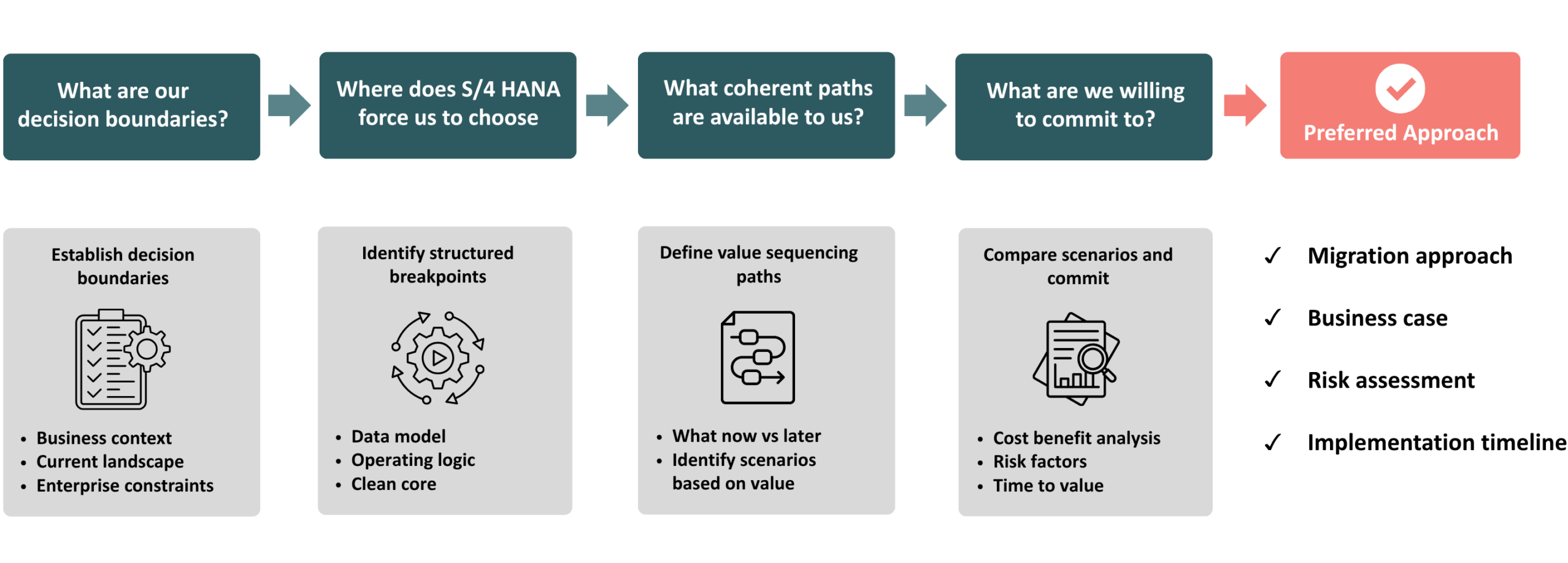
The discussion usually starts with methods, rather it should start with boundaries. Every organization operates within them: Regulatory requirements, landscape and Integration complexity, data obligations, contract and commercial commitments, capacity for change or business ambition. These realities shape what is feasible.
At the same time, S/4HANA changes the structural rules. The new finance backbone, harmonized master data model, and clean core expectations alter how the system evolves. Some of these shifts align naturally with the current landscape. Others introduce tension that cannot be ignored indefinitely.
Clarity emerges when these two dimensions are considered together. Different scenarios or positions can be articulated clearly enough to compare as alternatives. Each scenario represents a deliberate position on what is addressed in the foundation, what value is activated early, and what is intentionally staged or deferred.
Each scenario implies a different cost profile, concentration of risk, pace of value realization, and degree of long-term architectural flexibility.
When those implications are made explicit, the migration approach becomes a leadership choice grounded in visible trade-offs. And this shift, from debating methods to structuring consequences, is what turns a technical conversion into a strategic move.
Applying the Logic in Practice
Once positioning is treated as design decision, the distinction between Brownfield+ and Bluefield becomes clearer. Not as competing philosophies but as structured responses to different enterprise realities.
The difference is often visible when applied to context.
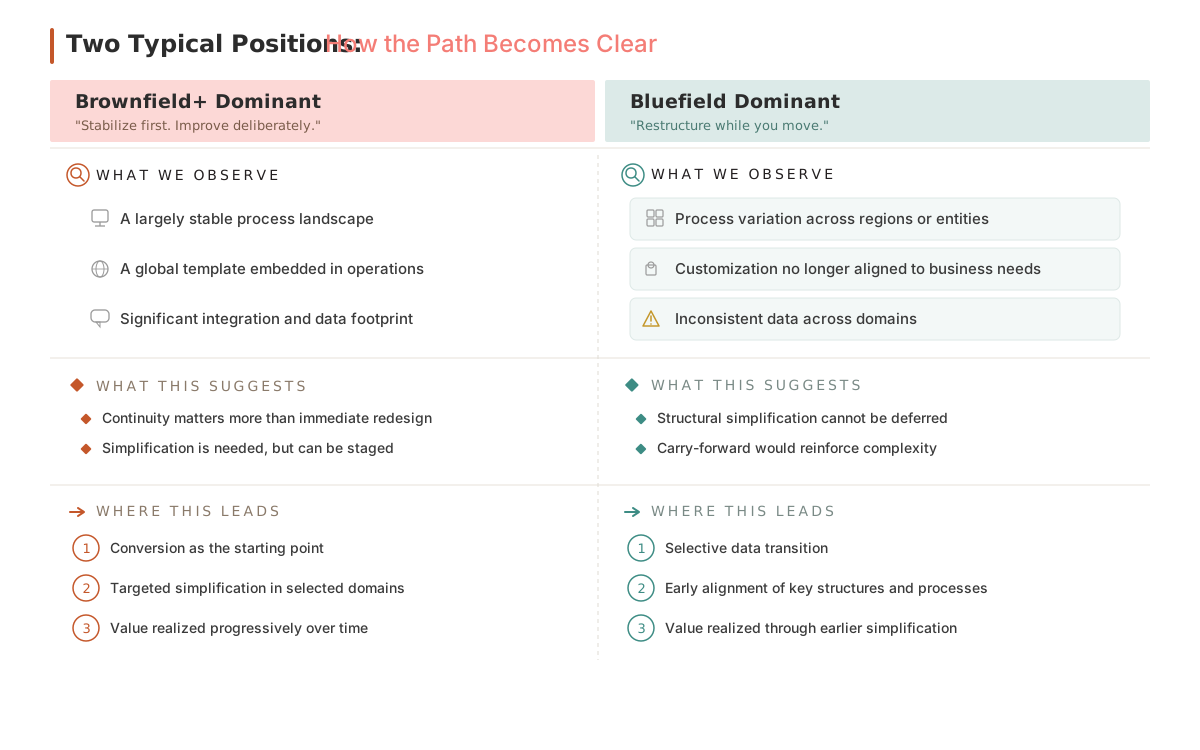
These examples illustrate a simple point: the migration path reflects context. Brownfield+ and Bluefield are not ideological choices. They are logical positions that emerge when enterprise boundaries and structural implications are considered together.
But positioning alone is not the end of the discussion. The next discipline is sequencing.
Staging SAP S/4 HANA Value: What Moves First and Why
Not everything should change at once. And not everything should wait.
Effective sequencing brings clarity across three key areas:
- What is structurally foundational and difficult to retrofit later?
- Where does early activation unlock business value?
- How much change can the organization absorb in the first move?
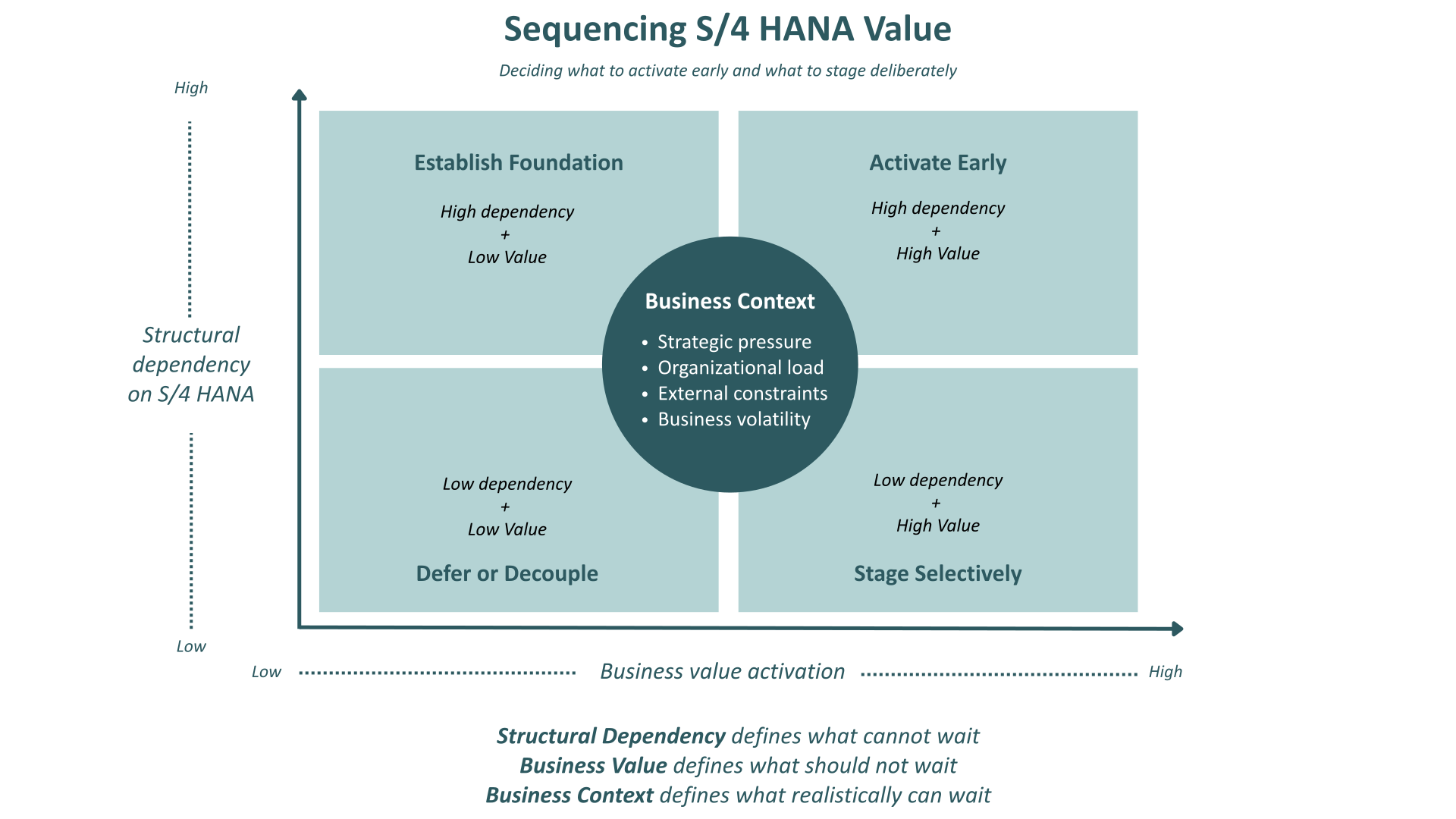
The first S/4HANA release should not aim to maximize transformation. It should establish the right foundation, activate selected high-value capabilities, and preserve optionality for what follows.
Sequencing is therefore not phase planning. It is an economic choice.
It determines:
- How cost is distributed over time
- Where risk is concentrated
- When value becomes visible
- And how much architectural flexibility remains
With positioning defined and sequencing clarified, the discussion moves from logic to commitment.
Closing Reflection
The move to SAP S/4HANA is inevitable. How it is framed is not. Migration method, positioning, and sequencing are not separate decisions. Together, they shape how the enterprise core evolves over time.
At Opticos, we work with leadership teams precisely at this inflection point where technical pathways intersect with enterprise design, economic consequence, and long-term architectural intent.


