Sweden’s banking sector stands at a critical inflection point. With strong digital adoption, well-developed infrastructure, and high levels of customer trust, the foundations for Artificial Intelligence (AI)-driven value creation are firmly in place. Yet, evidence points to a persistent gap between successful pilot projects and scaled enterprise adoption.
The challenge is no longer whether AI works, but whether banks can operationalise it as a core business capability safely, at scale, and under rigorous regulatory scrutiny. Those that fail to do so within the next 24 months risk falling structurally behind on cost efficiency, compliance effectiveness, and customer experience. To unlock durable value, Swedish banks must move beyond technology experimentation and adopt a deliberate strategy that integrates data management, operating models, governance, and talent.
The Swedish Advantage: A Strong Base for Leadership
Swedish banks are uniquely positioned to lead Europe in AI adoption. The market benefits from widespread digitalisation and a long tradition of collaboration between financial institutions and technology providers. With online banking penetration among the highest globally and widespread digital literacy supported by platforms like BankID and Swish, the “digital floor” is incredibly high. This advantage is reinforced by a constructive regulatory environment where supervisory authorities actively engage to enable responsible innovation.
Early proof points already exist:
- Nordea’s Nova AI: Operates across four markets using language-agnostic agents, achieving a 90% in-scope resolution rate and outperforming traditional chatbot solutions.
- Klarna’s AI Transformation: Demonstrates the scale of AI industrialisation by handling the equivalent work of 700 full-time agents. In its first month, the system managed two-thirds of all customer service chats while improving repeat inquiry rates by 25%.
- SEB’s Aida: Delivers personalised customer interactions that increasingly resemble human advisory.
- Swedbank’s participation in AI Sweden: Reflects the growing importance of cross-industry collaboration in accelerating AI maturity.
Global Benchmarking: What Scale Really Looks Like
Globally, the stakes are high; McKinsey predicts that AI could generate up to $1 trillion in additional annual value for the banking industry by 2030, with over 60% of banking executives reporting active deployment.
Leading global institutions are already demonstrating how AI delivers outcomes at scale:
- HSBC has deployed AI in compliance and risk monitoring, using machine learning to detect suspicious transactions and strengthen AML frameworks.
- JPMorgan Chase announced a $17 billion technology budget in 2024 and identified approximately 450 potential AI use cases ranging from fraud detection and call centre optimisation to AI-powered client advisory, contributing directly to revenue growth.
- Bank of America’s virtual assistant Erica has become one of the most widely adopted AI tools in banking, serving over 32 million customers and handling more than a billion interactions annually.
Beyond these headline examples, global leaders are also experimenting with AI-driven credit scoring models that incorporate non-traditional data sources, improving access to credit for underserved segments. In wealth management, banks are deploying AI-powered robo-advisors that deliver personalized investment strategies at scale. Goldman Sachs has invested heavily in AI for risk modelling and trading, while DBS Bank in Singapore is embedding AI into every customer journey, from onboarding to wealth management.
The common thread is clear: global leaders are moving decisively beyond pilots toward enterprise-wide AI platforms embedded across core banking functions. AI is no longer a side project; it is embedded into compliance, trading, and customer journeys. Importantly, these banks are not just investing in technology they are investing in organisational change, talent, and governance frameworks to ensure adoption sticks.
Where AI Delivers the Most Value
AI delivers the greatest impact in areas that matter greatly to the leadership team: customer experience, risk management, and operational efficiency.
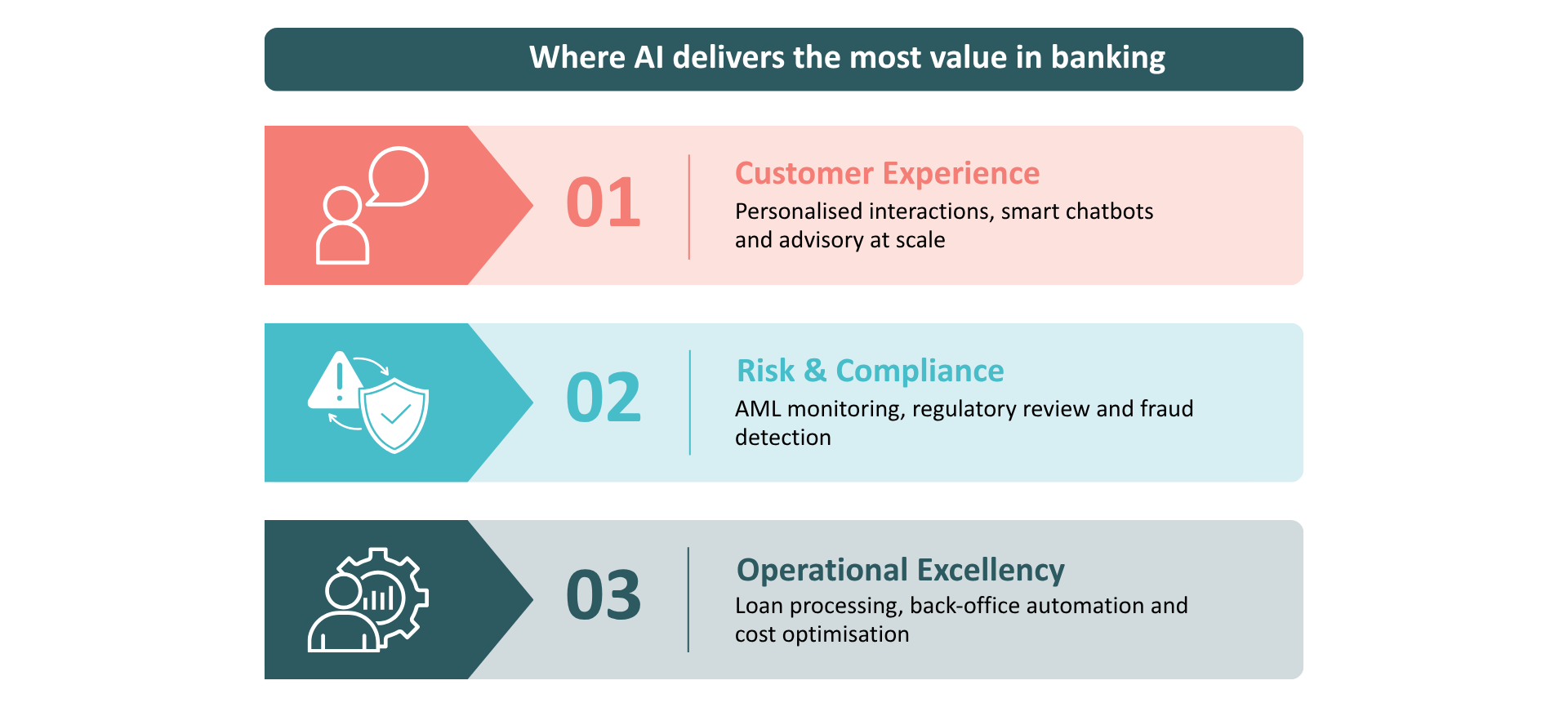
Customer Service
Smart chatbots do more than answer simple questions. They remember past interactions and enable contextual, personalised interactions that reduce friction and free advisors to focus on high-value engagements.
Risk & Compliance
Financial institutions have looked at use cases within the compliance and regulation area for a long time. Improving accuracy whilst driving more efficient processes is a key motivator. Compliance and AML have traditionally been manual and resource intensive. Handelsbanken, for example, has implemented an AI-based compliance tool built on IBM Watson technology to support more efficient document analysis and regulatory reviews. The solution combines AI’s ability to analyse large volumes of text with human judgement to interpret context, complexity, and regulatory nuance.
Operational Efficiency
AI streamlines operations for loans and investment tips. This allows market challengers like Avanza to gain market share while controlling their cost.
The Technology Setup that Enables Scale
To leverage the power of AI at enterprise level, banks need clear architectural foundations coupled with strategic technology choices. This setup pulls data together, runs AI smoothly, and keeps everything safe under EU rules.
- Infrastructure layer: A hybrid setup using cloud services for scalability and optimisation, coupled with an on-premises setup for resiliency and stability. This provides on-demand scalability while preserving operational control.
- Application layer: Platforms that manage the full AI process from testing ideas to daily use. These include embedded AI, in-house developed models and vendor-provided AI applications.
- Security & Trust Layer: Leveraging appropriate tools coupled with processes and control frameworks is at the core of successful AI-scaling.
In practice, many banks are making significant strategic investments to unify data and modernise their infrastructure to support AI at scale. Swedbank, for example, has embarked on a major data platform transformation, moving from a complex, on-premises analytics environment to a cloud-based enterprise analytics platform a foundational step toward becoming a truly data-driven bank.
Building the Team: People, Governance & Trust
Technology developments require new skills and adapted processes. In fact, AI rollout is generally held back by the human factor. Developing skills, organising people and updating processes are all necessary steps for organisations who wish to adopt enterprise-wide AI with a positive ROI.
Organisations that are leading in establishing enterprise-level AI are at the forefront of both upskilling their staff and making key recruitments to bring in new talent. They also adapt their governance models and ways of working to encourage an entrepreneurial yet safe environment.
Sweden is a small nation, but it is paving the way in AI through cross-industry and intra-industry collaboration forums; consider for example AI Sweden, a joint forum to encourage collaboration teaming with vendors and upskilling.
From Use Cases to an AI Operating Model
Most Swedish banks have already moved beyond experimentation. Individual AI use cases are live, value has been demonstrated, and returns are visible across areas such as compliance, customer service, fraud detection, and advisory. The challenge now is not whether AI works, but how to operationalise it at scale safely, consistently, and in line with regulatory expectations.
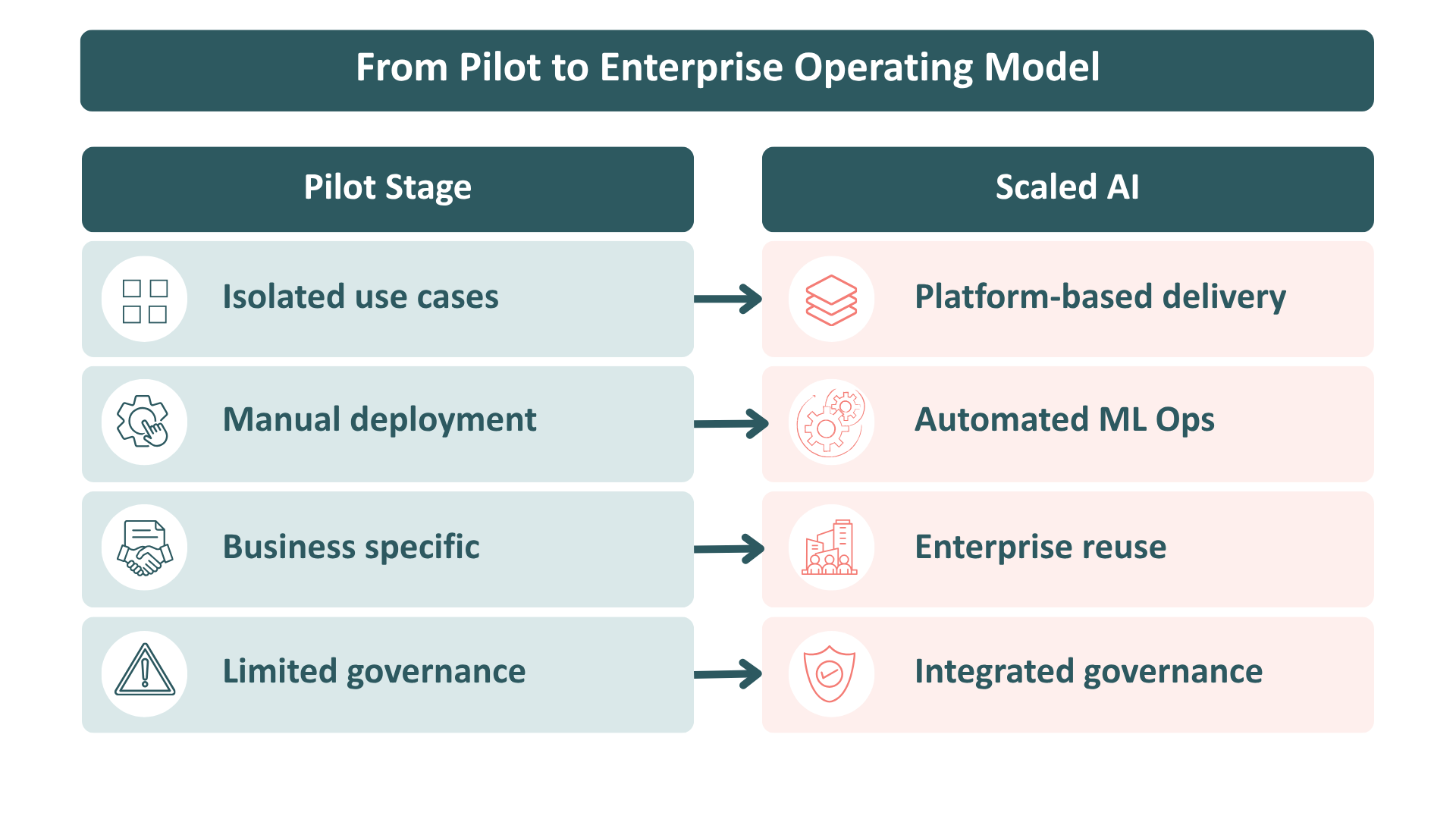
To make this shift, banks must evolve from a project-based AI mindset to an enterprise AI operating model. In our experience, this requires three core capabilities:
- Industrialise AI Delivery and Reuse
AI development in many banks remains fragmented, with teams building similar solutions in parallel across business lines. Scaling AI requires moving from bespoke use cases to industrialised delivery.
This means establishing shared data and AI platforms, standardised development patterns, and robust MLOps capabilities that allow models to be deployed, monitored, and updated reliably. It also requires clear ownership across the AI lifecycle from model development to production support so that successful use cases can be reused and scaled across the organisation, rather than remaining local successes.
The key question for leadership is no longer “Can we build AI?” but “How quickly can we scale a proven capability across the bank?”
- Embed AI into Core Business Processes
True scale is achieved only when AI is embedded into end-to-end business processes, not layered on top of existing ways of working. This requires rethinking how decisions are made, how workflows flow across functions, and where human judgement adds the most value.
Leading banks are integrating AI directly into core processes such as credit decisioning, transaction monitoring, customer onboarding, and investment advice. Human-in-the-loop models remain critical, but oversight is applied deliberately by exception or at defined decision points rather than by default.
At this stage, success is measured not by model performance alone, but by operational outcomes: cycle-time reduction, improved risk outcomes, and a demonstrably better customer experience.
- Govern and Trust AI at Scale
As AI becomes embedded in core banking processes, governance and operating discipline become decisive. Banks must be able to explain, monitor, and control AI-driven decisions under increasing regulatory scrutiny.
This requires clear accountability for AI outcomes, integrated model risk management, continuous monitoring for bias and performance drift, and governance frameworks aligned with evolving regulation, including the EU AI Act and DORA. Importantly, governance must enable scale not slow it down by providing clarity and confidence rather than friction.
At this level of maturity, AI is no longer treated as a series of initiatives, but as a core operational capability one that is continuously improved, tightly governed, and trusted across the organisation.
Looking Ahead: Staying Safe and Leading
AI introduces new risks alongside opportunity. Poor data quality, unmanaged bias, and excessive automation can undermine trust and reputation. Strong, enterprise-wide data governance is therefore not a constraint on AI, but the mechanism that enables it to scale with confidence.
Opticos supports leadership teams in making this transition aligning data management, AI strategy, governance, and operating models to ensure that AI initiatives deliver measurable, sustainable outcomes. Across our client engagements within Sweden, we consistently see that the real challenge is not AI technology itself, but bringing technology choices together with workforce capabilities, governance models, and data strategy requirements in a coherent way. By applying a disciplined, use-case-driven approach and fostering strong business-IT alignment, we help organisations translate AI ambition into real, sustainable value at scale.