As digital transformation accelerates, enterprises can no longer afford to treat IT as a siloed support function. Technology is now a strategic enabler – one that must deliver measurable business outcomes, drive innovation, and secure long-term competitive advantage. Yet despite growing IT budgets, many organizations still struggle to realize the full value of their technology investments.
A root cause? A lack of a shared, transparent baseline.
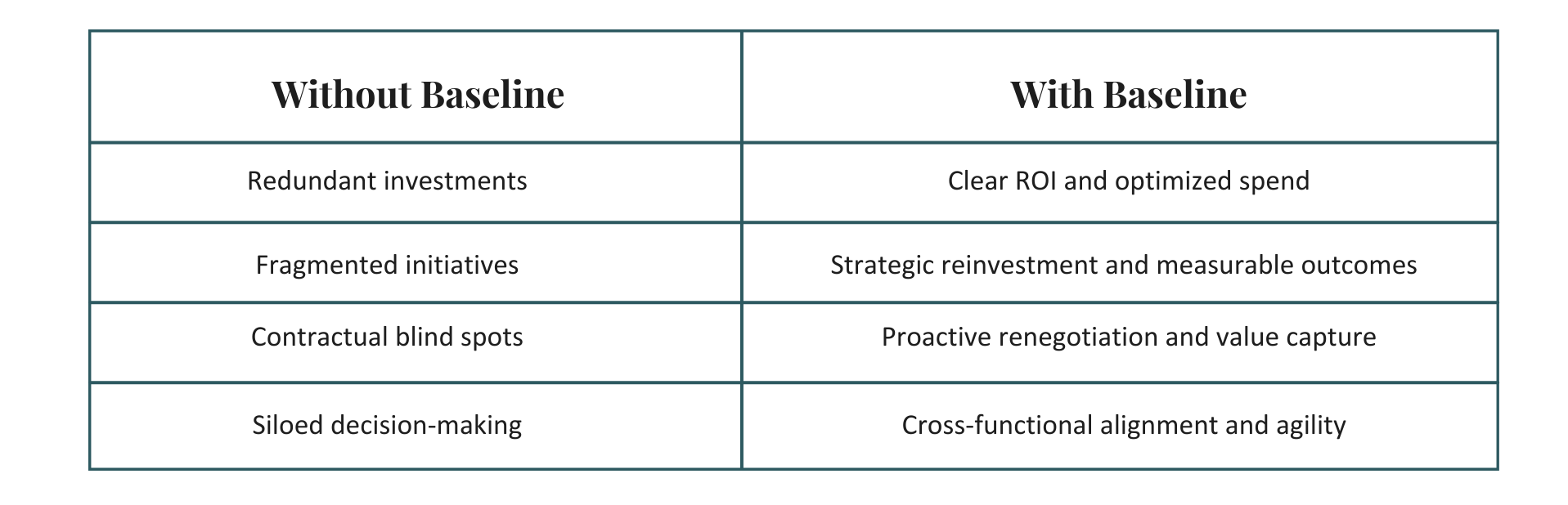
A baseline isn’t just a list of technology expenses. It’s a strategic tool – a shared view that helps the business understand where technology spend is going, what it’s supporting, and how it’s performing. When built properly, it becomes a living reference point that connects technology investments to business outcomes.
It helps leaders:
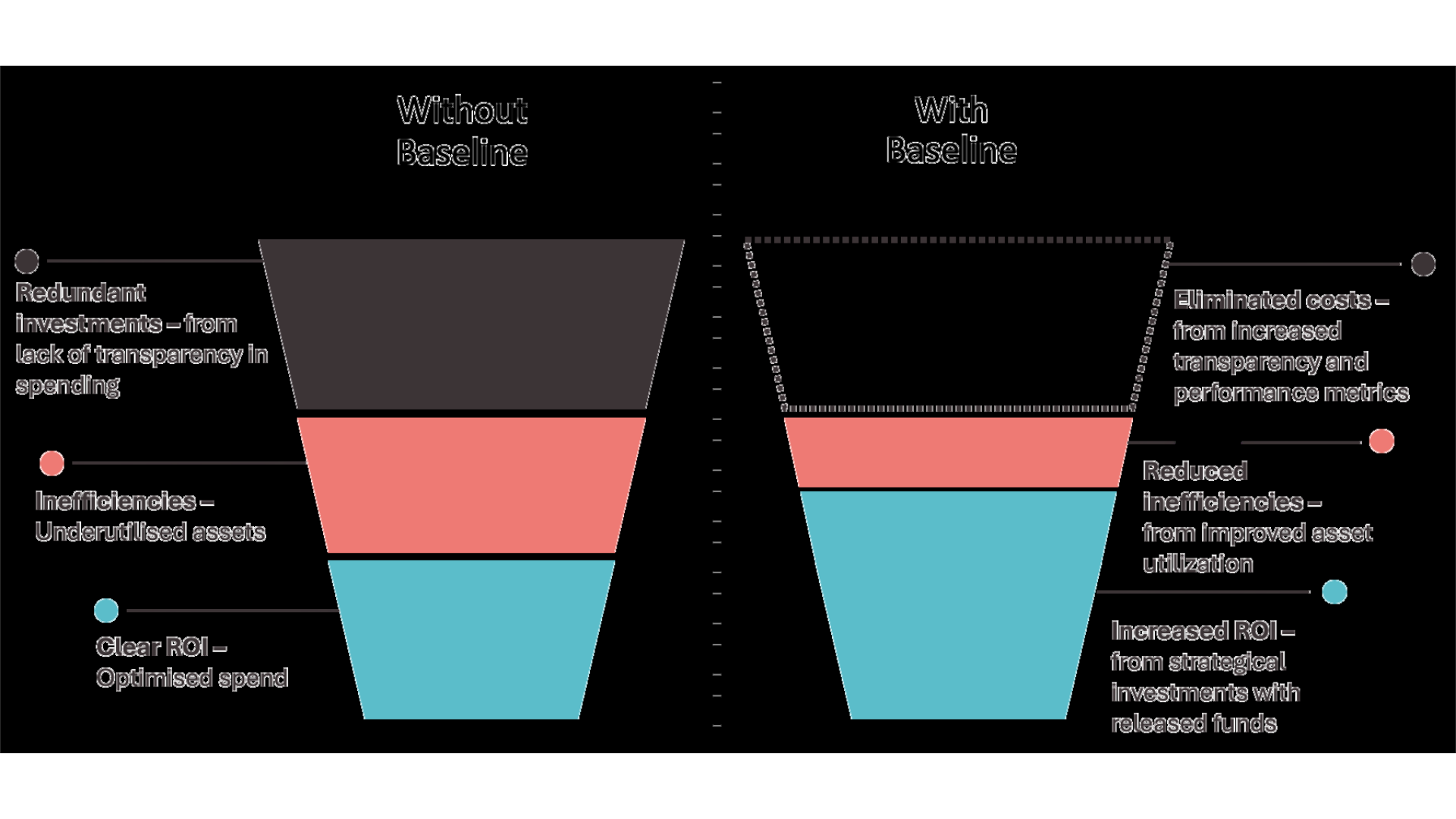
- Spot overlaps and inefficiencies – so they can reduce waste and improve utilization.
- Link spend to impact – making it easier to justify investments and redirect funds where they matter most.
- Make faster, better decisions – by breaking down silos and encouraging collaboration across teams.
- Find hidden opportunities – like contracts that can be renegotiated or tools that can be consolidated.
Based on our previous experiences, organizations have this kind of visibility. But in reality, they’re working from disconnected data sources, trying to piece together a mosiac that often ends up being wrong. A well-built baseline changes that. It gives teams a common language, a clearer view, and a stronger foundation for transformation.
Case in Point: 70M SEK in Twelve Months
Opticos recently partnered with a global manufacturing client to tackle this challenge head-on. By establishing a transparent baseline, the joint team identified and realized 70M SEK in run-rate savings within a year – exceeding top-down targets and creating headroom for new digital initiatives. Clear governance, vendor consolidation, and harmonized financial reporting ensured that the benefits were not only achieved but sustained. During the subsequent forecasting cycle, the client’s finance team uncovered additional bottom-up savings opportunities, underscoring the lasting impact of the baseline-driven approach.
The Hidden Cost of Siloed Decision-Making
As an outcome to the business case creation, we found that you managed to bridge the gap of the silos that exists within the organizations. In many enterprises, Technology transformation is hindered not by strategy, but by structural fragmentation. Sourcing, IT, and finance often operate in silos, each managing their own view of spend, contracts, and priorities. This disjointed approach leads to value leakage – where costs are not understood from a value perspective and categorization of cost is blurry. Thus, transformation efforts fail to deliver their full potential, and leadership is left without a clear line of sight from investment to impact.
Here is where the Opticos’ pragmatic approach to value architecture comes in – a structured approach that connects scattered technology spend to enterprise-wide value creation. It empowers IT, sourcing, and finance to build together, using a shared logic: measure, maximize, and communicate business value.
Establish the Baseline – Engage cross-functional stakeholders
So, what does it actually take to build and maintain a meaningful baseline? From our experience, a value-led approach requires the involvement from different disciplines; IT, Sourcing and Finance.
- Inventory All Technology Spend – Map all technology-related spend across business units, functions, and geographies, including hardware, software, cloud services, consulting, and support contracts.
- Map Spend to Business Capabilities and Value – Involve the business and link each spend item to the business process or capability it supports to reveal duplication, underutilization, and misalignment.
- Clarify Technology Cost Allocation – Identify the criticality of the business processes and capabilities across the two dimensions, runtime and new development.
- Analyze Asset Utilization – Evaluate how well existing tools and platforms are being used and identify idle licenses or overlapping tools.
- Assess Contractual Commitments – Review vendor contracts for lock-ins, renewal clauses, and performance metrics to identify value leakage.
- Enhance existing Governance – Redefine ownership, cadence, and accountability to keep the baseline current and actionable.
But a baseline is only as powerful as the insights it enables. To make it actionable, organizations should embed metrics and KPIs directly into the baseline. These measures go beyond cost categories and show how IT spend translates into business impact. Examples include:
• Asset Utilization Rate to reveal idle asset usage.
• Redundant Spend Reduction to track savings from tool consolidation.
• Contract Compliance to monitor vendor performance.
• Business Capability Coverage to ensure tech investments align with strategic priorities.
• Decision-Making Speed to measure supplier governance agility.
• Value Realization Index to link IT Supplier spend to outcomes like revenue growth or efficiency. These KPIs transform the baseline from a static financial snapshot into a dynamic performance framework. They define what “value” means, enable continuous optimization, expose inefficiencies, and create accountability across IT, Finance, and Sourcing.
Conclusion
By building the baseline together, IT, sourcing and finance create a common language for value – one that enables smarter decisions, faster pivots, and more impactful outcomes. The baseline becomes the toolbox which equips the decision-makers with the right information for streamlining non-core business capabilities and processes, while simultaneously enable target future investments on high-value strategic initiatives.
Food for Thought: Three Provocations for Leaders
• Is your IT baseline a strategic asset or a compliance checkbox?
• Are you measuring what matters or what’s easy?
• Are your teams collaborating or competing for budget?
What’s next: From Baseline to Value Realization
This article is the first in a series exploring how enterprises can move from cost to value, and from fragmented transformation to sustained impact. The next articles in this series will dive deeper into:
• From Cost to Value: Fuel your Transformation – Use the baseline to drive cost takeout and reinvestment, creating a self-funding transformation engine.
• Technology Value Realisation: The Benefits of Transformation – Move to a target IT finance model that embeds healthy governance between IT, finance, and business, ensuring sustainable value capture.