For many years, IT sourcing was primarily viewed through the lens of cost efficiency. Organizations focused on securing the right capabilities at the right price, often measuring success through savings targets, utilization rates, and contract performance.
Today, that mindset is no longer sufficient.
The business environment has become increasingly complex. Geopolitical uncertainty, regulatory pressure, cybersecurity concerns, talent shortages, and rapid advances in artificial intelligence are fundamentally changing how organizations approach sourcing decisions. At the same time, business leaders expect sourcing functions to contribute not only to operational efficiency but also to innovation, resilience, and long-term business value.
As a result, IT sourcing is evolving from a procurement-driven activity into a strategic business capability.
The question facing CIOs and sourcing leaders is no longer how to source services more efficiently. The question is how to build sourcing strategies that enable organizations to adapt and compete in a rapidly changing environment.
What Is Driving the Shift?
Several forces are reshaping the sourcing landscape simultaneously.
Geopolitical tensions, regional conflicts, and changing trade policies are forcing organizations to reassess supplier locations and concentration risks. Regulatory requirements around data sovereignty, cybersecurity, operational resilience, and sustainability continue to increase across industries and regions. At the same time, organizations face growing pressure to accelerate digital transformation while controlling costs.
Perhaps the most significant catalyst, however, is artificial intelligence.
Unlike previous technology shifts, AI is not simply changing the services organizations buy. It is changing how services are delivered, governed, measured, and priced. Traditional assumptions around labor-based delivery models, productivity, and sourcing economics are increasingly being challenged.
This combination of market forces is creating a sourcing environment where flexibility, resilience, and adaptability have become just as important as cost efficiency.
Five Leadership Shifts for the Future of IT Sourcing
The sourcing leaders who succeed over the next decade will likely approach sourcing differently from those who succeeded over the previous one.
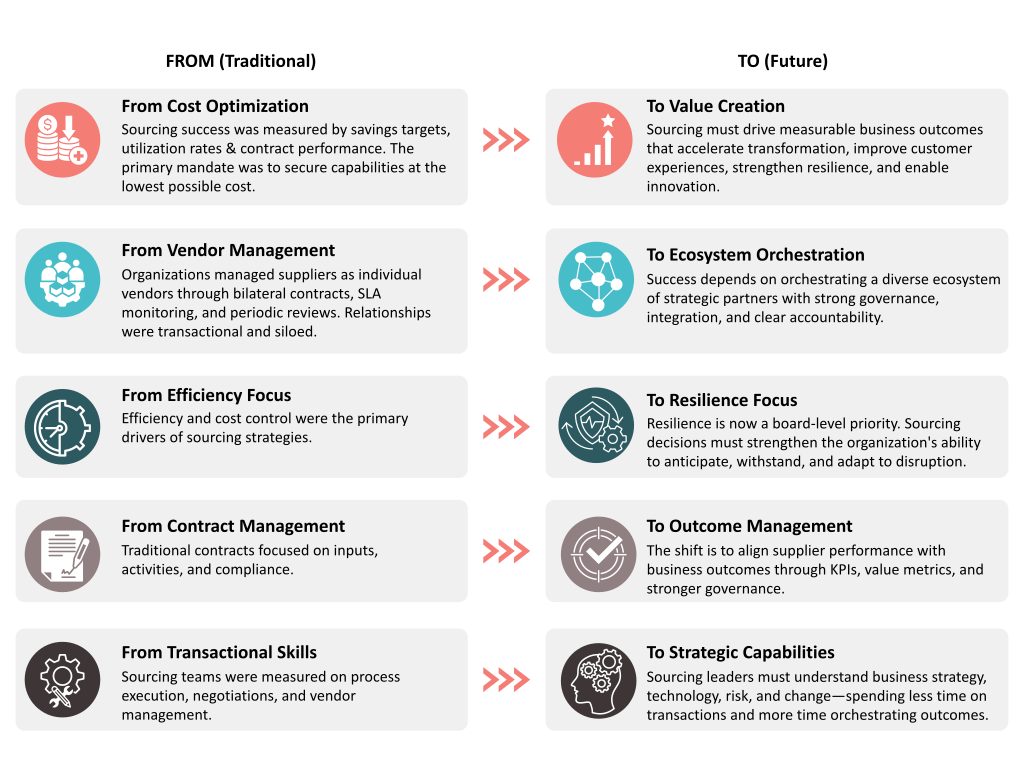
1. From Cost Optimization to Value Creation
Cost reduction will always remain important, but it can no longer be the primary objective of sourcing decisions.
Organizations are increasingly evaluating sourcing initiatives based on their ability to accelerate transformation, improve customer experiences, strengthen resilience, and enable innovation. The focus is shifting from achieving lower costs to creating measurable business outcomes.
The most effective sourcing strategies balance efficiency with strategic value creation.
2. From Vendor Management to Ecosystem Orchestration
Many organizations have deliberately moved away from single-vendor strategies in favor of diversified supplier ecosystems.
This shift helps reduce dependency risks, provides access to specialized capabilities, and increases flexibility when business priorities change. However, managing multiple strategic partners introduces new complexity.
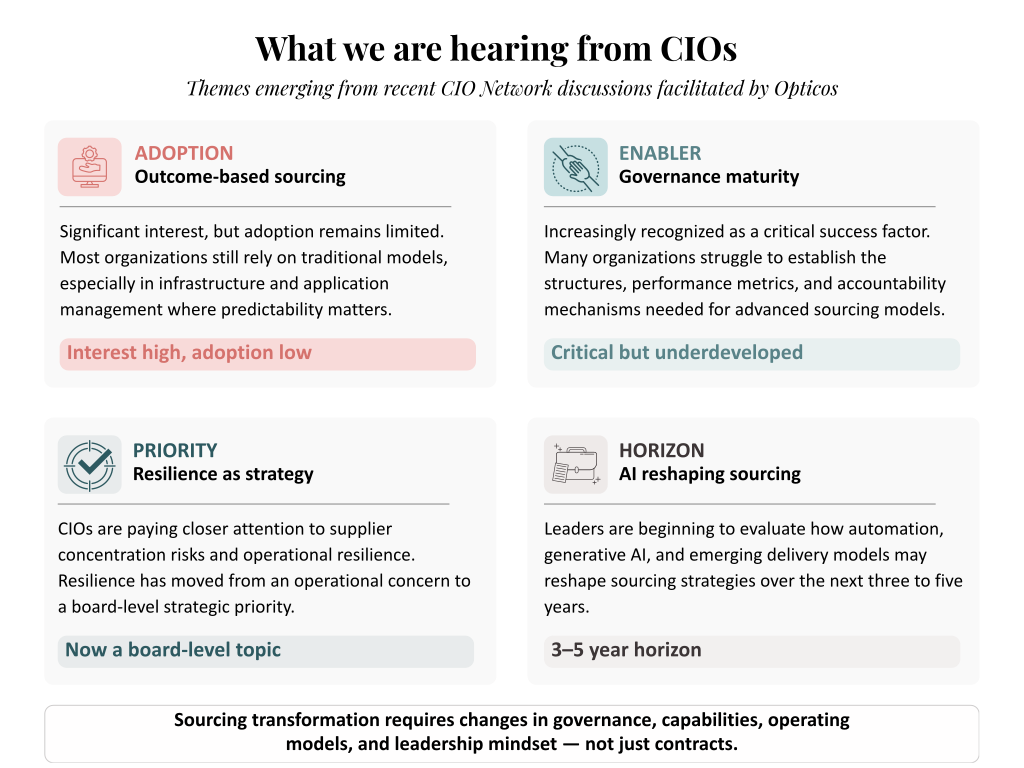
Success increasingly depends on the organization’s ability to orchestrate a broader ecosystem of suppliers rather than simply managing individual vendor relationships. Governance frameworks, service integration capabilities, and clear accountability structures become critical enablers.
3. From Efficiency Focus to Resilience Focus
Recent years have demonstrated how quickly external disruptions can affect business operations.
Supply chain disruptions, cyber incidents, geopolitical events, and regulatory changes have elevated resilience from an operational concern to a board-level discussion.
As a result, sourcing decisions are increasingly evaluated through a resilience lens. Organizations are reassessing supplier concentration risks, geographic dependencies, business continuity capabilities, and operational resilience requirements.
The ability to withstand disruption is becoming a competitive advantage in its own right.
4. From Contract Management to Outcome Management
Outcome-based sourcing models continue to generate significant interest across industries. The promise is compelling: stronger alignment between supplier performance and business objectives.
However, the reality is more nuanced.
While many organizations are exploring outcome-oriented approaches, traditional time-and-materials and fixed-price models continue to dominate large parts of the market. Defining measurable outcomes, establishing accountability, and consistently tracking business value remain challenging for many organizations.
Rather than replacing traditional contracts entirely, many leading organizations are embedding outcome-based KPIs, value metrics, and stronger governance mechanisms into existing sourcing arrangements.
The shift is less about contract structure and more about creating genuine alignment around business outcomes.
5. From Transactional Skills to Strategic Capabilities
Perhaps the most important shift concerns the capabilities sourcing leaders must develop.
Historically, sourcing teams focused heavily on procurement processes, contract negotiations, and vendor management activities.
Today, sourcing leaders are expected to understand business strategy, technology trends, AI implications, operating model design, risk management, and organizational change.
The sourcing leader of the future will spend less time negotiating rates and more time orchestrating business outcomes.
Technology as a Sourcing Enabler
Technology is transforming not only what organizations source, but also how sourcing is executed.
Artificial intelligence is enabling more informed supplier selection, predictive risk management, demand forecasting, and automated sourcing workflows. Advanced analytics provides deeper visibility into supplier performance, spending patterns, and operational risks.
Cloud-based platforms continue to simplify collaboration across suppliers, business units, and geographies while enabling greater agility and scalability.
Meanwhile, technologies such as blockchain are improving transparency, traceability, and trust across increasingly complex supplier ecosystems.
Organizations that effectively leverage these technologies will be better positioned to make faster, data-driven sourcing decisions and adapt to changing business conditions.
A Leadership Playbook to Stay Ahead
To stay ahead in the current era of IT sourcing, CIOs must adopt a proactive and strategic approach. The following roadmap offers a guide for sourcing strategies:
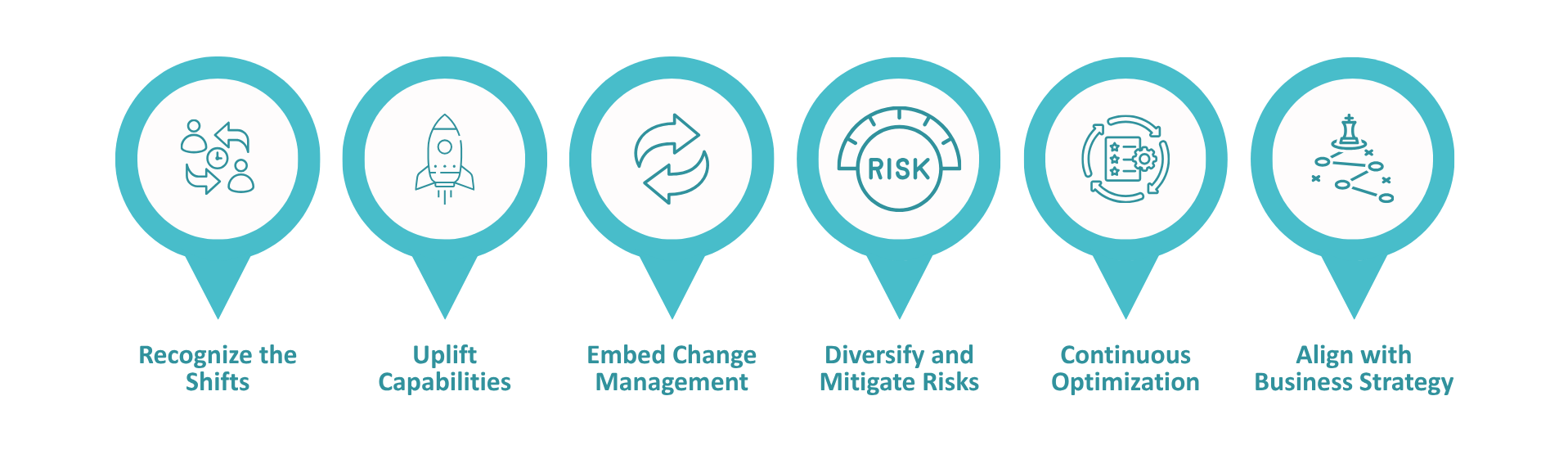
- Recognize the Shifts: Stay informed about global disruptions, technological advancements, and regulatory changes. These factors influence sourcing decisions and require regular monitoring.
- Uplift Capabilities: Invest in the development of sourcing expertise within the organization. Enable teams with the skills to design and execute strategies that deliver enterprise-wide outcomes.
- Embed Change Management: Technological adoption must be accompanied by cultural change. Effective change management ensures smooth transitions and better ROI.
- Diversify and Mitigate Risks: Build a resilient supplier base by diversifying partners across geographies. This reduces dependency and enhances agility during disruptions.
- Continuous Optimization: Use analytics to evaluate and improve efficiency. Continuous optimization ensures sourcing remains aligned with growing business needs.
- Align with Business Strategy: Focus on a collaborative, not a siloed, approach to drive innovation and competitive advantage.
Conclusion
IT sourcing is no longer a support function focused primarily on cost optimization. It has become a strategic lever for business transformation, resilience, and competitive advantage.
The next generation of sourcing leaders will not be defined by their ability to negotiate better contracts. They will be defined by their ability to build resilient ecosystems, harness emerging technologies, and translate sourcing decisions into measurable business outcomes.
In a landscape shaped by AI, geopolitical uncertainty, and increasing regulatory expectations, sourcing is becoming a strategic leadership discipline rather than a procurement function.
Organizations that recognize this shift early will be best positioned to navigate change and create sustainable value in the years ahead.


