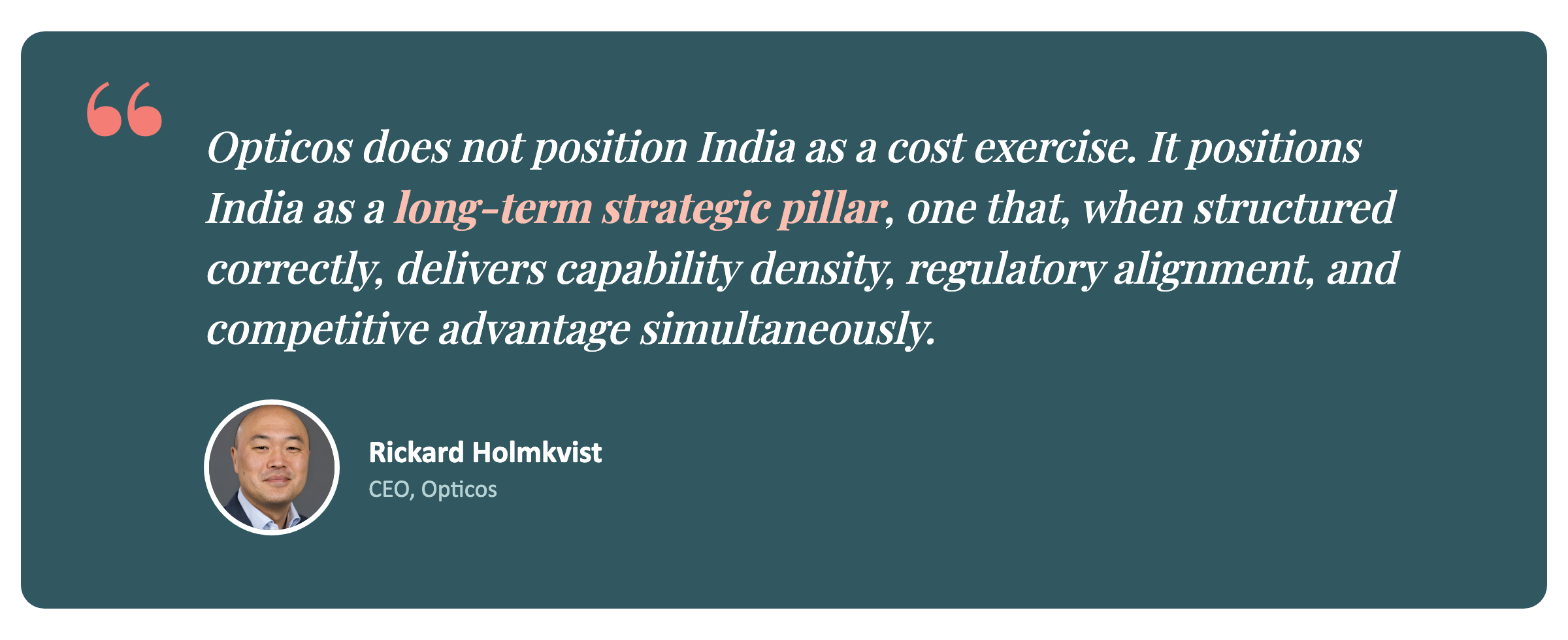
India has moved beyond being just an offshore delivery option for Nordic financial institutions and has become a strategic platform for technology, risk, compliance, data, and AI-driven transformation. In the past twenty years, India has changed from a cost-focused destination to a mature hub for global financial services. European and Nordic banks now run delivery centers in several cities, supporting core technology, regulatory reporting, digital transformation, and control functions on a large scale.
For Nordic institutions evaluating offshore expansion, one question consistently rises to the top: Is India regulator-ready? The answer, increasingly and demonstrably, is yes. The more important question is now how deliberately India should be embedded into the global operating model, and under what governance architecture
India’s Regulatory Maturity: From Emerging Market to Established Ecosystem
India’s financial regulatory framework – overseen by the Reserve Bank of India (RBI), SEBI, and IRDAI – has matured significantly. It is structured, increasingly transparent, and experienced in supervising global institutions operating at enterprise scale.
More importantly for Nordic institutions, India-based teams have deep hands-on experience supporting compliance with European regulatory standards. These include:
- Basel III/IV capital and liquidity frameworks
- IFRS reporting and consolidation standards
- AML, KYC, and financial crime compliance
- Stress testing, model risk management, and capital planning
This dual alignment of local regulatory structure combined with EU-grade compliance expertise allows Nordic institutions to design offshore operating models that are both globally integrated and locally compliant. India also provides robust data infrastructure, including enterprise-grade data centers, data localization options, and governance frameworks that can be aligned with GDPR and Nordic data protection expectations.

For Nordic banks, this matters because the strategic challenge is not merely finding scalable talent; it is finding a location where high-value work can be performed within a control environment that satisfies supervisory expectations, internal risk appetite, and board-level accountability.
The Evolution of Financial Services Operations in India
The role of India within global financial services operating models has undergone a fundamental transformation, one that is directly relevant to how Nordic institutions should think about their own expansion.
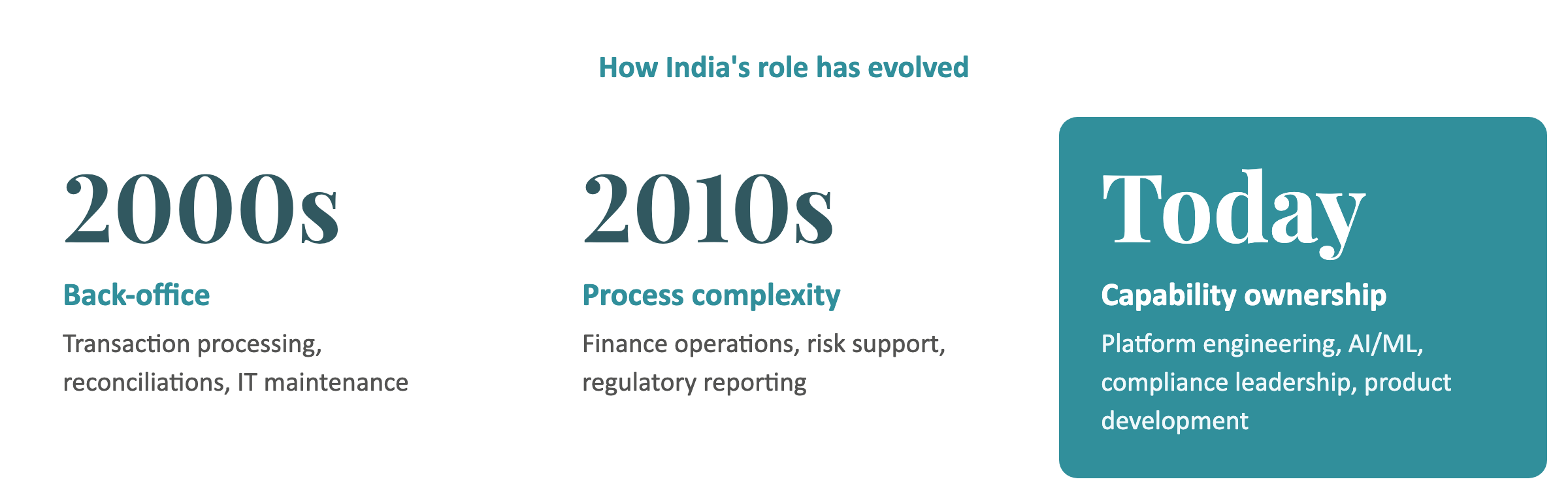
This shift from execution support to capability ownership signals that India is no longer an experimental offshore location. It is a well-established environment capable of supporting high-value, regulator-intensive functions with clear accountability structures.
Global Financial Institutions in India: From Support to Ownership
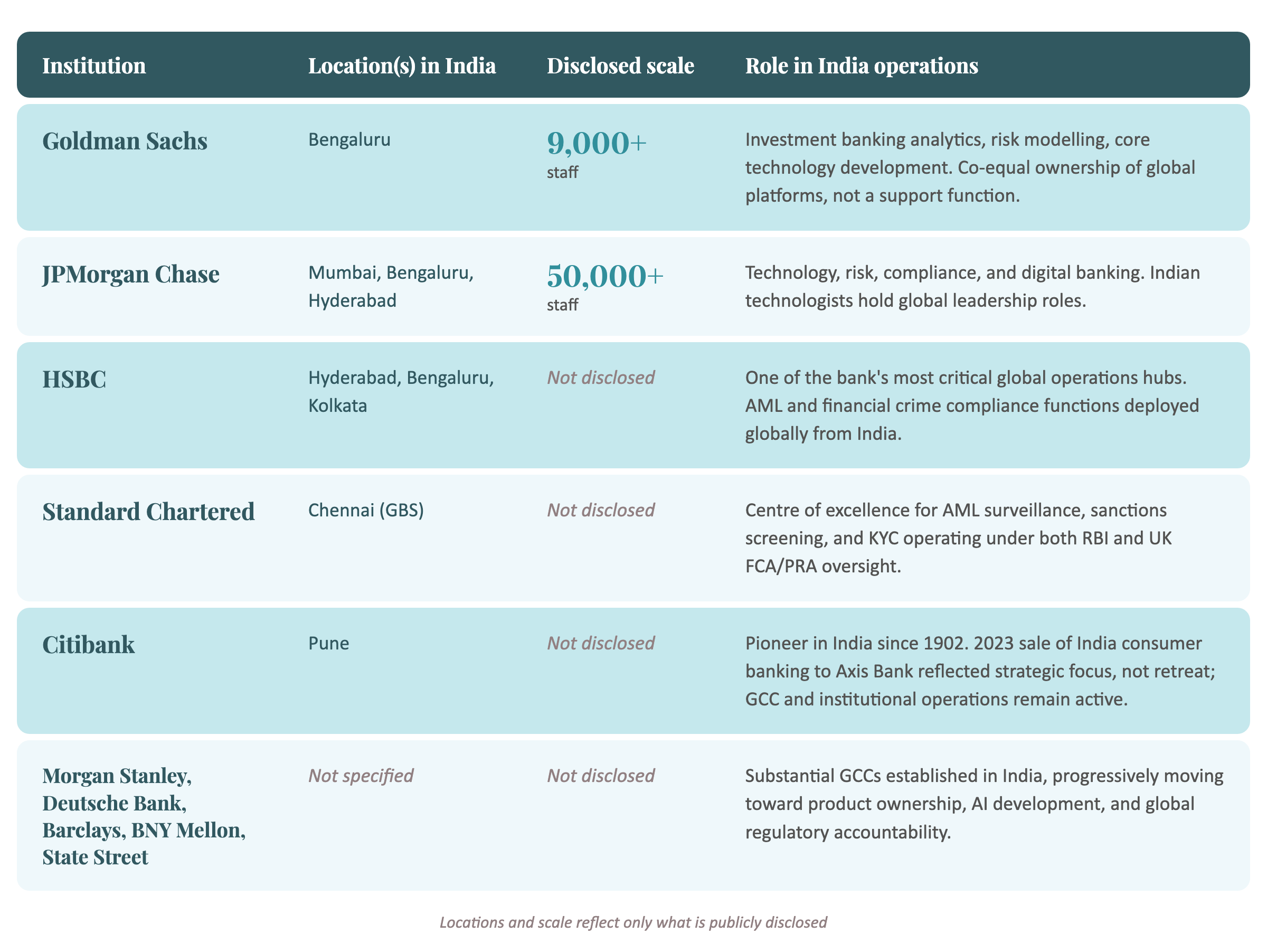
The experience of global financial institutions shows that India has moved well beyond transactional support. The most relevant pattern is not simply headcount growth, but the shift toward ownership of platforms, controls, analytics, and global regulatory processes.
Key Institutions and Their India Journeys
The examples below illustrate three themes: India-based teams increasingly own global platforms rather than only supporting them; risk, compliance, and financial crime functions are already operated from India at scale; and several institutions use India as a base for product, data, and AI-led capability development.
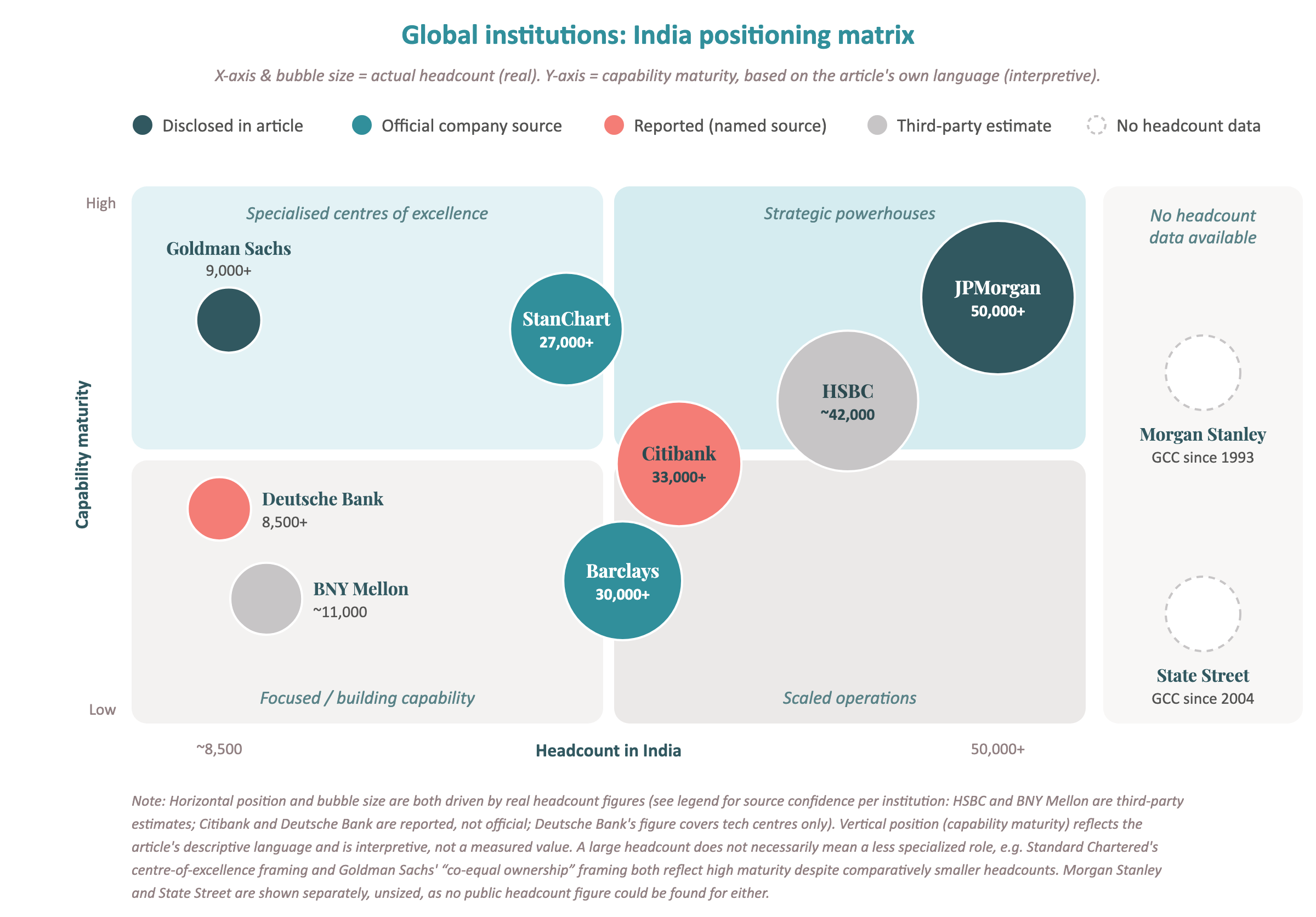
Where This Is Heading
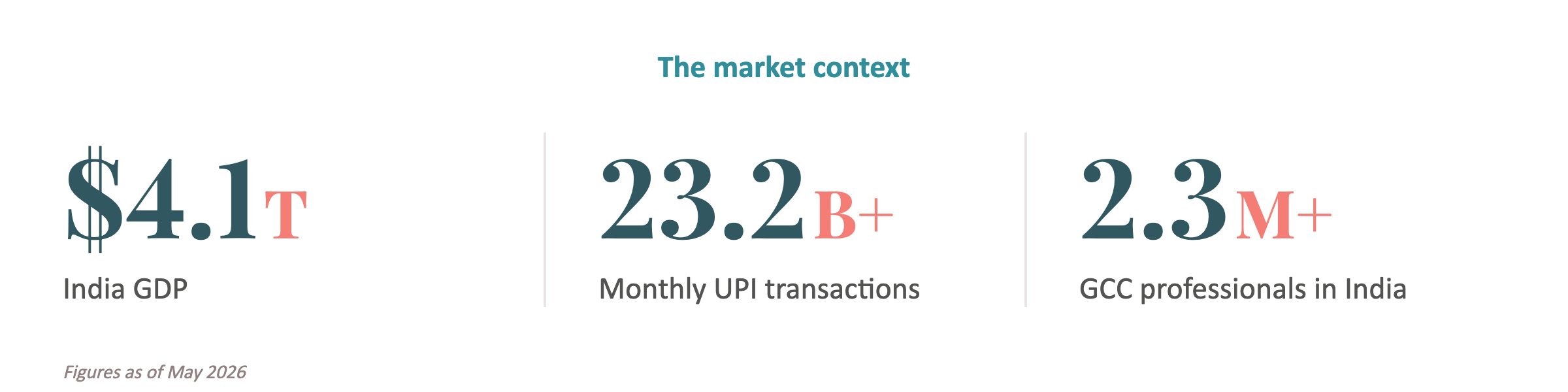
The direction is clear. GCCs are evolving into global hubs with greater platform ownership. India’s AI and data engineering talent now drives innovation, not just execution. With a $4.15 trillion economy (IMF, April 2026) and UPI now processing over 23 billion transactions monthly (NPCI, May 2026), India serves as both an operating platform and a high-growth financial market. Institutions that establish early, credible relationships in India will have a structural advantage in the coming decade.
The Nordic Model: Capability-Led, Governance-First
Nordic financial institutions tend to approach offshoring differently from large global universal banks. Rather than prioritising headcount scale, they typically favour capability density: lean, high-skill teams focused on digital, cloud, payments, data, and compliance excellence and India supports this model well.
It is worth noting that Nordic banks have, to date, largely favoured nearshore models such as Poland and the Baltics, as well as vendor-managed delivery, over India captives. Where India captive experiments have occurred – Danske Bank’s approximately 1,400-person Bengaluru IT centre being the most prominent example- the model has not always been sustained. Danske Bank transitioned its Bengaluru IT center to Infosys in 2023, moving from a captive model to a vendor-managed arrangement while continuing to rely on the same India-based capability.
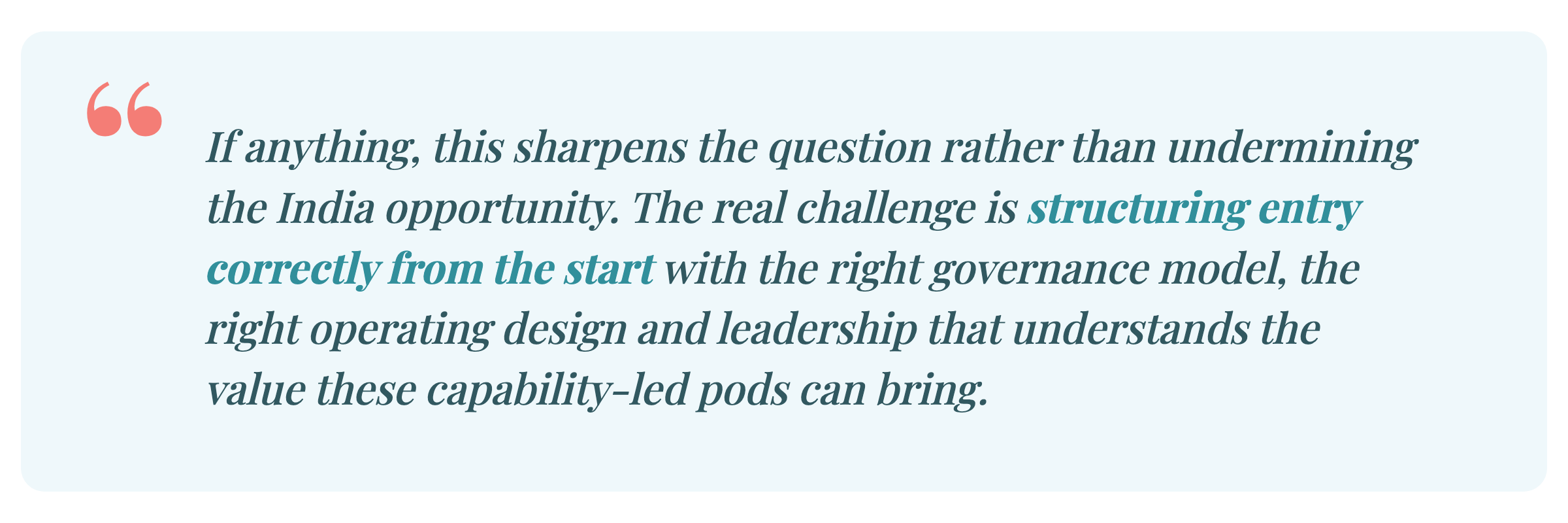
India offers a proven environment for capability-led models, but success requires more deliberate design than many nearshore arrangements demand.
The AI Inflection Point: Redefining Offshore Value
AI is fundamentally reshaping how financial institutions design their global operating models and India sits at the centre of this shift.
The transition is already underway. Financial services institutions are leveraging India-based teams to:
- Build and train AI/ML models for fraud detection, credit risk assessment, and customer analytics.
- Automate regulatory reporting and compliance monitoring at scale.
- Enhance AML and financial crime detection through pattern recognition and anomaly detection.
- Accelerate software engineering through AI-assisted development pipelines.
- Improve operational efficiency through intelligent automation and process mining.
This evolution has two important implications for Nordic institutions planning India expansion:
- India should be designed as a governed AI and data capability hub, not a labour-arbitrage centre. Nordic institutions that treat AI as a control, data, and accountability challenge from the outset will be better positioned to scale responsibly.
- Operating models must connect technology delivery with risk ownership. AI-enabled work cannot sit outside governance; it must be embedded into model risk, compliance, cyber, data protection, and supervisory engagement frameworks.
For Nordic institutions, the implication is clear: India should be entered with a capability blueprint that defines which decisions, controls, and accountabilities will sit in India not only which activities can be migrated there.
This is where the discussion moves from market opportunity to execution. The India opportunity is compelling, but the value is only realised when entry is sequenced, governed, and integrated into the institution’s broader strategic agenda.
The Road Ahead: The AI-Era Financial Services GCC
The GCC of the future won’t look like the delivery centers of the past. As AI takes over routine work – from coding and reconciliations to reporting and document reviews the role of people will naturally shift. Success will depend less on executing processes and more on applying judgement, overseeing AI, and making better business decisions. This shift will reshape GCCs in three ways:
- Work: AI will handle repetitive tasks, while people focus on exceptions, governance, and complex business decisions.
- Roles: Traditional operational roles will give way to AI-focused roles such as model validators, AI risk specialists, and data product owners.
- Capabilities: GCCs will evolve from delivery centres into AI innovation and governance hubs, responsible for both building and overseeing intelligent systems.
For Nordic financial institutions, this presents a unique opportunity. Without the burden of legacy offshore models, they can build AI-first GCCs from the ground up – leaner, more specialized, and designed for higher-value work.
The question is no longer whether India is ready, but how Nordic institutions can work with the right partners to shape operating models that reflect their own strategic priorities, governance expectations, and long-term capability ambitions.
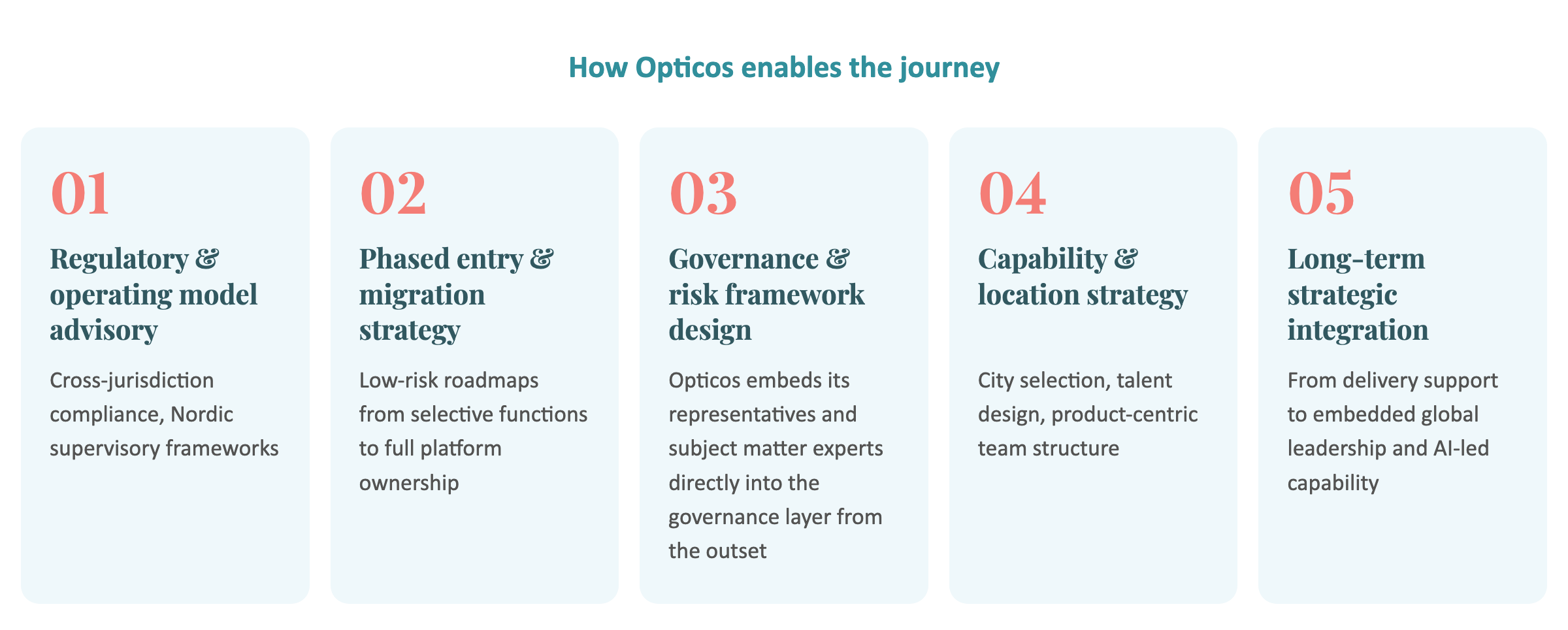
How Opticos Enables this Journey
India is not a cost play. It is a capability platform and for Nordic financial institutions, it remains largely untapped. The institutions that move now, with governance architecture, risk ownership, and capability design in place from day one, will be structurally advantaged in talent access, innovation velocity, and supervisory readiness.
The next decade will not be defined by which institutions have the largest offshore headcount. It will be defined by which institutions have built the deepest capability and where AI is accelerating this shift faster than most operating model strategies anticipated.